NB: I wrote this for an EA-adjacent audience. That might not be you. You might well read this and think that the romance is missing. But I think opportunity favors the well-prepared: romance has a way of showing up in surprising situations — and it’s well worth it.
***
Why family plan?
What do you want your life to look like at age 75? If you’re picturing having had a family and a career, and maybe having some grandkids, you’ll want to think now about how to get there. You’ll want to “family plan” in the literal sense, and the sooner the better.
Why start now? Because timing is everything.
Fertility doesn’t last forever (not even for men!), finding a partner can be tricky, and most of the good that results from dating and childrearing happens at the tail end of your life.
We know that a lack of such planning is a problem for a lot of people today:
- Multiple governments are discussing the loneliness crisis, because living alone (if undesired) is associated with a range of negative health outcomes.
- A Pew Research Center analysis of American census data finds that in 2019, roughly four-in-ten adults ages 25 to 54 (38%) were unpartnered – that is, neither married nor living with a partner. This share is up sharply from 29% in 1990. Among adults ages 40 to 54, there has been a significant increase in the share who are unpartnered from 1990 (24%) to now (31% in 2019).
- Even when partnered, the inability to have children (if a family is desired), leads to adverse mental health outcomes.
- 1 in 6 people worldwide are impacted by infertility, and the likelihood increases with age. This doesn’t just matter for women. Most people are in partnerships with someone of roughly the same age, so if you are partnered with a woman or intend to be, you will also be impacted by the female fertility cycle. (And male fertility is also impacted by age! Further discussed below.)
And most importantly, in my opinion, spending time with spouses and families is just good. If you wait until late in your lifespan to have them, you get to spend less time with the people who you love the most. After all, Your Real Biological Clock Is You’re Going to Die (this is the best article I’ve ever read on the subject. I highly recommend it).
So what should you do to get the life outcome of a partner, kids, and maybe even grandkids? Two steps: (1) find a partner; (2) plan your reproductive life.
Finding a partner
Finding a partner is often treated as a matter of luck, but it is not. Or insofar as it is, as Louis Pasteur said, luck favors the prepared. Two things are important when it comes to relationship success: (1) being exposed to many potential good partners; (2) not trapping yourself in a mediocre partnership. I emphasize the latter, because I see this as the biggest problem for the people in my social circle.
- Finding a partner
Chris Olah recommends, tongue in cheek, micromarriages. I think these are brilliant.
A micromarriage is a one in a million chance that an action will lead to you getting married, relative to your default policy.
The average American is exposed to around 50,000 micromarriages a year between 18 and 35, but this varies greatly from person to person. With careful analysis and effort, you can increase your exposure!
Even if you’re doing everything right, romance is a highly stochastic process, where you very seldom see reward. There’s lots of events that don’t lead to dates, dates that don’t lead to relationships, and relationships that don’t work out. It can all be pretty disheartening.
Micromarriages can help you gamify this process. Even if the date doesn’t go anywhere, you can feel good about the estimated micromariages counting up. This helps you acquire more and more micromarriages — and hopefully find a partner!
To find a partner, you need exposure to people in your dating age-range. It mostly takes lots of at-bats. These at-bats can be found in lots and lots of ways, but you can’t just rely on them to come to you.
- Avoiding getting trapped
In general, it is really hard to break up. Unless something is really wrong, lots of people will stay in decent but not perfect relationships for much longer than they otherwise would have wanted to. This can especially be a problem if you want kids one day; having kids is scary, and it’s hard to “force” yourself to do that with the wrong person (though many do!).
When dating, if you want kids, you should be asking yourself: would I have children with this person? You’ll want to do this earlier than you think (age discussed in the next section), because it’s possible (easy?) to start dating someone at 22, carry on through the “next steps” in the relationship, and wake up at 30 realizing that you actually wouldn’t want to share this person’s DNA. (Birth control might contribute to this by altering mate choice preferences, but the magnitude of the effect is unknown).
My big advice? Don’t move in with someone who you aren’t intending to have children with – and who isn’t sure they want to have children with you. A good but not perfect proxy for this is whether you’d be willing to marry them. Two potential bad outcomes from cohabitating as “next step” or “test run” are: (1) a break-up right when you were intending to begin having children; (2) having children with someone you wouldn’t want to otherwise because of fertility concerns (I have 3 friends in this boat—though some would argue that settling is actually the right thing to do).
- There is an association between cohabitation and divorce, though the data is very messy. One reason this association might exist is the argument from inertia, which has implications for fertility: “Briefly, the inertia perspective suggests that some relationship transitions increase constraints and favor relationship continuance regardless of fit, knowledge of possible relationship problems, or mutual clarity about commitment to the future of a relationship, or all.”
I personally think it’s avoiding the inertia problem which explains survey outcomes like this one:

(For what it’s worth, there is also a fairly strong association between marriage and decreased likelihood of breaking up over the course of the relationship, so I would recommend marriage over verbal or non-legal commitment if you want to have kids.)
Planning a family
When should you start having kids? Well, it depends on how many you want to have. Luckily, there’s information about that! Once again, Chris Olah’s blog is a fantastic resource.
He created this chart, which shows the likelihood of maximum family size given a starting maternal age.

What impacts my family size?
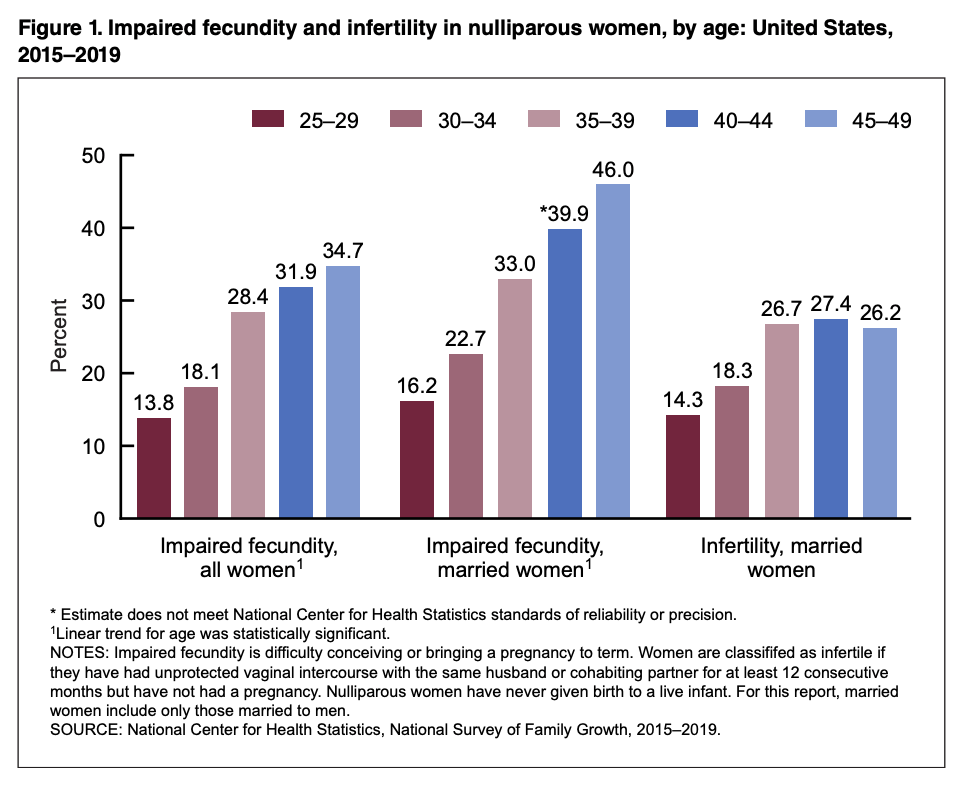
As you can see, the maximum age for successfully achieving most family outcomes is lower than you might expect. 30, the average age that a college-educated American woman has her first child, is for many scenarios too late, especially if you want more than one child. And for women ages 30-35, one in ten will already suffer infertility.
Why is that? Because aging decreases egg quality.

This both decreases the likelihood of pregnancy and increases the likelihood of genetic diseases:

There are other complications with advanced maternal age pregnancies (35+) that also impact live births. As you can see, there is a steep decline the number of women who give birth through their thirties.

Okay, but what about the men?
Aging also lowers sperm quality! It is more possible for men to have children later, but that’s not necessarily a good outcome for the kids. Though once again, the data is messy: there are no RCTs for this stuff. See, for instance, this study done which compared children born earlier and later in their fathers’ lives:

(And the criticism of it by Emily Oster here).
Genetic problems increase by age of men as well.
Age of the father has greater impact than maternal age on cases of sporadic autosomal dominant congenital diseases such as Apert, Crouzon, Pfeiffer, Noonan and Costello syndromes, multiple endocrine neoplasia (types 2A and 2B) and achondroplasia… Paternal age increases the frequency of congenital diseases such as heart malformations as well as oral, palate and lip cleft. Moreover, mental disorders (autism, schizophrenia, bipolar disorder, low IQ level as well as ADHD) also occur more frequently in advanced father’s age. Advanced paternal age is defined differently in every research. It depends on disorders in offspring we are talking about. Paternal age has an impact on child’s health and development and it is as significant as maternal age, when it comes to reproductive matters.
Aging can matter for other reasons. If you’re subfecund, or have other health issues, it can take more time and assistance to have children. This matters for both men and women because infertility is roughly equally shared:
Many different medical conditions and other factors can contribute to fertility problems, and an individual case may have a single cause, several causes, or—in some cases—no identifiable cause. Overall, one-third of infertility cases are caused by male reproductive issues, one-third by female reproductive issues, and one-third by both male and female reproductive issues or by unknown factors.4
It’s worth noting that conceiving is not very easy. Humans have a harder time conceiving than other animals. Most people do not understand the female reproductive cycle.
This is an old article, but the data hasn’t improved much. Researchers gave women a questionnaire with basic questions about women’s fertility:
Only one woman in 12,382 who completed the survey was able to correctly answer all 15 questions about reproduction. More than half the multiple-choice questions were answered incorrectly.
Most people don’t know that women can only get pregnant 6 days out of the month, and that the likelihood of conceiving in a given month is at most 20%(but often less, depending on age and fertility status).
This tool is quite helpful for figuring out your likelihood of conception given your age. If female, you can find your fertile window using temperature tracking and cervical mucus monitoring (the mucus is really cool).
How to plan
How then should one think about when to have children? Work backwards! Decide how many you would like and your comfort level of risk.
For example, if you want two kids, spaced 15 months apart, at 80% likelihood, the latest you can begin having children may be 32. Assume that you want to be married/firmly committed for at least a year, and it takes two years of dating to feel comfortable with the decision to get married. Assume also that you’ll have at least 1 relationship beforehand that doesn’t work out (~2 years) and some time spent going on dates in between (maybe 6 months between each). At 26, then, you’ll want to be dating with kids in mind.
Of course, this doesn’t account for the increased likelihood of genetic diseases, which doubles from 30 to 34. You may want to lower that likelihood and pick instead the last age you’re comfortable with the risk. If you want no lower than 1 in 1000, you’ll want your last kid at 30, and you’ll need to begin 3 years earlier (dating at 23 for partners) or shorten your intervals between children.
What if you’re already past the age for getting the number of children you’d like at a given probability?
There are ways to improve one’s fertility outcomes. Leaving aside the medical industry, there are two quick ways to up your chances:
- Consider improving egg quality
- Increase the likelihood that you’ll conceive at a given month via natural family planning
- I love Natural Cycles & Oura ring
Grandkids
I mentioned grandkids a bunch of times above, but you might think: “That seems to be out of my control. It’s up to my children whether or not to have their own kids.”
Well, kind of. The more kids you have, the more likely one of those kids will choose to have their own.
I get this from Bryan Caplan’s Selfish Reasons to Have More Kids (very enjoyable, even though I think he overhypes the twin study data.)
But think ahead to your golden years. How many kids do you need to get as many visits, phone calls, and grandkids as you would like? 5? 10? An old saying tells us that “One parent can care for five children, but five children cannot care for one parent.” It could happen to you.
Basic microeconomics recommends a simple strategy. Have the number of children that maximizes average utility over your whole lifespan. When you are 30, you might feel like two children is plenty. But once you are 60, you are more likely to prefer ten sons and daughters to keep you company and keep the grandkids coming. A perfectly selfish and perfectly foresighted economic agent would strike a balance between these two states. For example, he might have four kids total – two too many at 30, six too few at 60.
Trust me – you’ll thank me later. Your third child ought to thank me too, but we all know better than to expect gratitude from the young. Now all you have to do is convince your spouse!
Happy planning!
 Joan O'Bryan
Leave a comment